About CIAS
Aims & Objectives
Channel Islands Air Search is a voluntary service providing a rapid response airborne search and rescue service in Channel Island waters.
We operate on a 24 hour, 365 day basis in all weathers and provide service to the rescue centres of the Channel Islands, the French CROSSMA and CROSSCO centres on the adjoining French coast and, on occasions, the English Coastguards.
We provide a rapid response search capability in the 4,000 square miles of water surrounding the Channel Islands and the adjacent French coast.
This area is notorious for strong tides, changeable weather, large seas and submerged reefs. It is also one of Europe's highest density areas for leisure boaters. A yachtsman's paradise but it can be not without its risks.
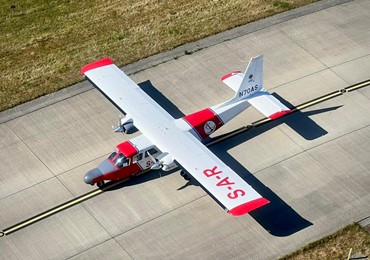
Our aircraft operates in conjunction with Lifeboats, SAR helicopters and other rescue craft. The aircraft is equipped with search radar, night vision, smoke floats, radio homing and loud hailer system.
Our aircraft is operated entirely by volunteer crew. The operational base is Guernsey Airport, where CIAS has its own purpose built hangar.
The Lifeboats' eyes in the sky
Organisation & Management
The organisation is a wholly voluntary one. Many of the aircrew are serving corporate and commercial pilots.
It is believed that CIAS operates one of the most sophisticated yet economical fixed-wing airborne search and rescue operations in the world and the service is thought to be unique within Europe, possibly the world.
The organisation is managed by a Board of Trustees.
Funding
We do not make a charge for performing searches or responding to calls for standby.
The funds required to equip and run the aircraft are raised almost exclusively within the Channel Islands, and come from a wide variety of sources, including collecting boxes, social events and donations, flag days, bequests and even contributions for the scattering of ashes from the air.
In each of the four major Channel Islands, there is a supporters' organisation, "The Friends of Air Search", who are instrumental in raising the majority of the required funds.
A number of Channel Island companies and institutions agree to sponsor individual searches; some Governmental assistance has also been provided.
The cost of purchasing and equipping the CIAS Islander aircraft, Lions' Pride, was in excess of £2.7 million. The capital cost of providing the hangar was £150,000.
The annual running costs vary from year to year, but are budgeted (exclusive of capital costs) at £300,000.
The purchase and installation of an advanced third generation Forward Looking Infra Red camera (FLIR), located beneath the nose of Lions' Pride, cost £240,000.

Lions' Pride has a Forward Looking Infra Red camera (FLIR) located beneath the nose.
Guiding principles
In order to promote the willingness of our "customers" to call for assistance, we have adopted three simple principles, which are:-
(i) We will not solicit a donation from anyone to whom we have provided assistance.
(ii) We will not make any claim for salvage.
(iii) We will not make a public comment concerning a particular casualty which comment is critical of a person's actions.
The underlying reason for adopting these principles is the belief that those likely to be in need of assistance should be given every encouragement to seek help as soon as possible and before a crisis has arisen.
Consideration of cost, a possible salvage claim or adverse public comment could delay any request for help until matters are getting out of hand.
Liaison
In an average year, CIAS may expect between 30 and 40 calls for service. Of these, about 60% will result in searches being flown, the remainder being calls to readiness only.
We encourage agencies to initiate a call-out at the earliest possible stage, which inevitably leads to a substantial number of stand-downs. This is considered preferable to delaying the call-out, as past experience points to possible loss of life resulting from such delay.
We have provided assistance to a wide variety of casualties, from large ferries to wind surfers and from aircraft to hang-gliders.
Following the completion of each search, an incident report is prepared by the Search Director. This is circulated to all crew, all authorities using CIAS, and to certain other persons. They may also be published on the website in a suitable form.
The reason for circulating all authorities, irrespective of whether they were instrumental in a particular search or not, is to provide them with an overall view of the tasks undertaken by the crews of CIAS, together with a note of any particular observations which may be of value in future operations.
At the end of each year, all addressees are also provided with a brief resume of the past year's operations and a short statistical analysis.